
Education In-Plant Leader Hub
Map your in-plant's arc from Cost Center to Campus Expert. Four playbooks, one scorecard, and coalition guides.
The strongest in-plants do more than produce work. They make their value visible before the budget review, the outsourcing proposal, the leadership transition, or the strategic planning conversation puts that value on trial. That does not happen all at once.
How to use this hub
Maybe students are not getting materials in the format they need. Maybe teachers and faculty keep routing around the shop because the workflow feels too hard to use. Maybe advancement, admissions, or athletics is sending high-value work to commercial vendors. Maybe IT, finance, legal, or compliance is already asking about data, vendors, devices, and documentation.
That question is your entry point.
You do not need to prove everything at once. You choose the value stream the institution is most ready to hear about. You baseline the work for 90 days. You translate the numbers into the language your coalition uses. Then you bring the answer into the room before someone else frames the question.
One value stream. One coalition. One 90-day baseline. That is enough to begin.
Every one of those conversations, pursued with discipline, moves your operation along the same arc: from a shop that processes requests to one the institution recognizes as a strategic asset. This hub maps that arc and gives you the tools to walk it.
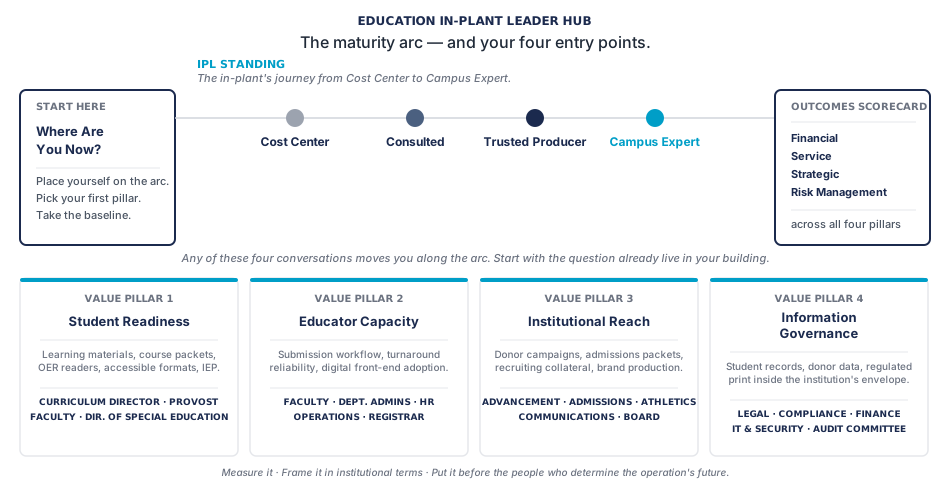
The arc
Most education in-plants move through a familiar arc.
Find your place on the arc
Most leaders have a sense of it already. A few honest questions turn that sense into something you can name, and into a first move you can actually make this term.
A few honest questions
A few questions worth sitting with. There's no score and no sign up. Just a clearer picture of the arc, and where you stand on it, that you can take into a conversation.
The Outcomes Scorecard
The Outcomes Scorecard does not ask the in-plant to measure everything. It asks the in-plant to measure the few things that travel to leadership.
| Domain | What it measures | Anchor metric | The question it answers |
|---|---|---|---|
| Financial | Cost efficiency and cost avoidance compared with commercial alternatives | In-plant vs. commercial cost comparison by job type | Are we getting good value for what we spend? |
| Service | Production reliability and responsiveness across the academic calendar | On-time rate · First-time-right rate | Can the shop be counted on when it matters most? |
| Strategic | Contribution to learning, communication, enrollment, advancement, and institutional priorities | Satisfaction or outcome reporting by department or value stream | Is this operation advancing the institution's priorities? |
| Risk Management | Governance discipline, audit readiness, and data handling in a regulated environment | Job documentation completeness and chain-of-custody readiness | If something goes wrong, can we answer with records? |
Each playbook in this hub deepens one part of the scorecard. Student Readiness strengthens the service and strategic story around student-facing materials. Educator Capacity strengthens the service story around submission workflow and practitioner trust. Institutional Reach strengthens the financial and strategic story around high-value communication. Information Governance strengthens the risk management story around data handling, documentation, and vendor exposure.
One more thing worth naming: the maturity signal isn't only in the scores. It's in the relationships those scores make possible.
The people this scorecard reaches at each stage of the arc are not internal customers. They are a coalition. Not people you report to, but people you work alongside in service of the institution you share. A Finance Officer who has seen three years of cost comparisons comes to the budget conversation as a partner, not an auditor. A Curriculum Director who receives a quarterly on-time report stops wondering whether the shop can be counted on and starts defending it. A General Counsel who understands how the in-plant handles regulated print data is in the room with you, not across the table from you.
Each pillar playbook in this hub names the coalition specific to that value stream: the people whose questions it answers, whose concerns it anticipates, and whose trust it builds over time. The scorecard is the tool that earns you a seat in those conversations.
Four value streams. One strategic arc.
Each one is a different conversation with a different coalition, and any one of them, pursued with the discipline of the playbook and the rigor of the scorecard, moves you along the arc.
You don't choose based on what's most important in the abstract. You choose based on what question is already live in your institution.
Each playbook recommends a single, narrowly scoped first baseline. You do not need to measure everything. You need to measure the thing that lets you hold the next conversation with evidence in hand.
Start the conversation
The first 90 days are simple to describe. Choose one value stream. Name the coalition that needs the answer. Pick two or three anchor metrics from the playbook. Track the work for 90 days. Translate the result into the coalition's question: cost avoided, time returned, risk reduced, materials delivered on the institution's calendar. Then hold the first conversation, and decide what the next 90 days should measure.
Take the first baseline. Build the first 90 days. Let the credibility compound. We'll bring 70 years of in-plant experience to the conversation. You bring the question that's already live in your institution.