
Education IPL Playbook — Student Readiness

The materials students hold come through your shop. All of them, for all students.

Course packets, exam booklets, OER readers, intervention sets, accommodation formats. Prove the role your shop plays in student readiness.

A course reader before Week 1. An assessment booklet during finals. An intervention packet after the data changes. A large-print accommodation set before the lesson starts. A multilingual version that reaches the right family in the right language. Each job may arrive from a different office, but the question underneath is the same:

Can the institution count on the in-plant to produce student-facing materials in the right format, on the right timeline, with the right documentation?

This playbook helps you build that answer.

Start with one 90-day baseline. Track the student material jobs that matter most. Translate the results for the people who care about them: curriculum, academic affairs, faculty, special education, library, and OER leaders. Then use the numbers to make the shop's value visible before the next budget, equipment, or outsourcing conversation begins.

Playbook at a glance

The whole playbook in one view

Coalition partners, maturity arc, build modules, and reporting cadence. The detail follows below; this is the map.

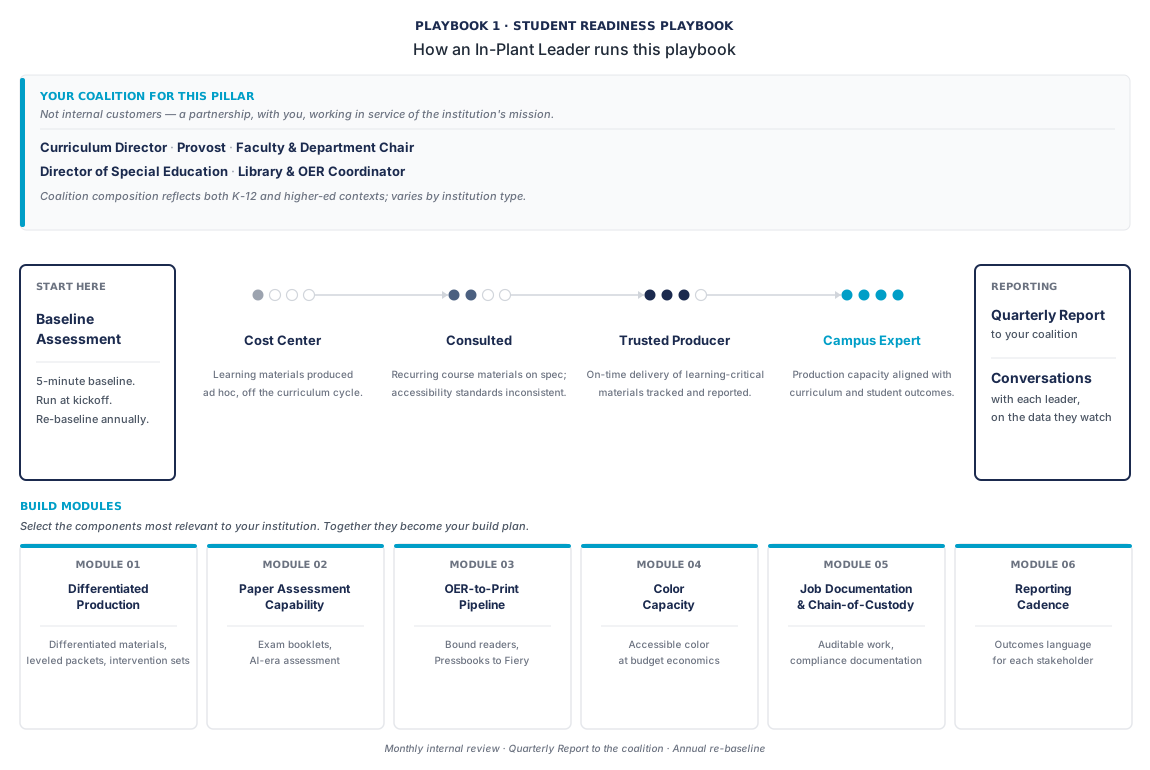
Student Readiness playbook diagram. Coalition: Curriculum Director, Provost, Faculty and Department Chair, Director of Special Education, Library and OER Coordinator. Maturity arc: Cost Center, Consulted, Trusted Producer, Campus Expert. Six build modules: Differentiated Production, Paper Assessment Capability, OER-to-Print Pipeline, Color Capacity, Job Documentation and Chain-of-Custody, Reporting Cadence. Cadence: Monthly internal review, Quarterly Report to the coalition, Annual re-baseline.

The work this proves

What this playbook helps you prove

Student-facing work is often treated like routine production until something goes wrong.

A course reader arrives late. A faculty member cannot get exam booklets turned around in time. A resource teacher is still assembling accommodation packets by hand. A library team has OER content, but the path from export to bound reader is unclear. A district wants differentiated materials ready by Thursday, but the work is still living on teachers' desks.

Those moments are not small inside the institution. They affect the people responsible for instruction, access, affordability, assessment, and student support.

This playbook gives you a way to show the shop's role in that work. It helps you answer four practical questions:

  • Which student-facing jobs should be treated as learning-critical?
  • How reliably are those jobs delivered on time and correct the first time?
  • Where do specifications, files, formats, or handoffs break down?
  • What would it take to move from reactive production to measured, trusted student material support?

The goal is not to explain every capability of the shop. The goal is to prove the connection between the work your team produces and the readiness of the students who use it.

The starting frame

Start with the jobs students actually touch

Student Readiness begins with the work that lands in front of students.

In higher education, that may be a printed OER reader built from a Pressbooks export, an exam booklet for a faculty member shifting assessment back to paper, or a lab manual students need open beside the work. In K-12, it may be an intervention packet, a differentiated reading set, or an accommodation format specified in an IEP or 504 plan. In both settings, the value is not the print itself. The value is whether the material is ready, usable, and produced to the standard the learning moment requires.

That is the distinction this playbook protects.

Some jobs can move through the shop as standard production. Others need a different level of attention because the academic consequence is higher. A student material job becomes learning-critical when timing, format, accessibility, privacy, or assessment integrity affects whether the material can be used as intended.

The first task is to name those jobs clearly.

Once the shop can distinguish learning-critical work from ordinary volume, the scorecard becomes more useful. Overall on-time performance may look fine while the jobs that matter most are still creating stress for faculty, teachers, or student support teams. The learning-critical slice is the number that travels.

The scorecard

The Student Readiness scorecard

These are the metrics most likely to matter in a Student Readiness conversation. They are practical enough to baseline in 90 days and specific enough to carry into conversations with academic leaders.

If you are running the Outcomes Scorecard quarterly, pull these rows for your curriculum, faculty, provost, special education, and library/OER conversations. If you are not running it yet, this is where to start.

The metric that travels furthest is learning-critical on-time rate. Academic leaders do not benchmark overall on-time against anything. They remember the week orientation packets were late or exam booklets did not arrive by morning. Track the learning-critical slice separately — it is not the same number as overall on-time, and it is the one that gets quoted back in the next budget cycle.

The student material rows of the Outcomes Scorecard. Use these as your quarterly baseline for the Student Readiness conversation.
Metric What it shows How to use it
Learning-critical on-time rate Whether student-facing jobs — course packets, OER readers, exam booklets, orientation kits, intervention sets, accommodation runs — arrived before the class, exam, intervention, or deadline that depended on them Track separately from overall on-time rate. This is the number curriculum, faculty, and academic affairs leaders remember.
First-time-right rate for student materials Whether the job was produced correctly on the first run, with no reprint or correction Track the reason for each reprint. A file problem, format problem, equipment issue, or spec gap tells a different story.
Turnaround by job type How long it takes to move from request to delivery for recurring student material work Use median turnaround, not average. Separate OER readers, exam booklets, intervention packets, and accommodation runs where possible.
Bad input rate How often jobs arrive incomplete, unclear, or not ready for production This is the upstream discipline metric. It shows whether the submission process is helping the shop or consuming prepress time.
Peak period performance Whether the shop holds together during the periods when the institution is most exposed Track the periods that matter in your setting: back-to-school, Week 1, finals, assessment cycles, orientation, or course adoption windows.
Documentation completeness Whether the shop can show what was requested, produced, delivered, and documented Use this for jobs with accommodation, assessment, student record, or course-section sensitivity.

The first 90-day baseline does not need to be perfect. It needs to be honest.

If you can only start with three numbers, start with learning-critical on-time rate, first-time-right rate, and bad input rate. Together, they show whether the shop is delivering the material, producing it correctly, and receiving the inputs needed to do the work efficiently.

The coalition

What each coalition cares about

Your coalition does not measure this work in first-time-right rate. They measure it in whether the thing they cared about happened on time, the way it was supposed to, for the students it was supposed to reach. The section below translates the shop's numbers into each person's question — and maps the conversation you will need to have.

Filter by chair

Curriculum Director — differentiated instruction at large (primarily K-12)

Curriculum Director

For curriculum leaders, the question is whether the production layer actually supports the instructional plan. If teachers are still making intervention packets in the staff room, the shop may be capable — but the workflow has not become the trusted path yet. If differentiated materials arrive late or need rework, the curriculum office feels it as teacher time lost and instructional rhythm interrupted.

The question she is actually asking: Across the full range of differentiated work my teachers are designing — leveled materials, intervention packets, translated communications, accommodation formats — is production actually there for them, on time, for every student it is designed for?

Common objections: "Teachers are still printing their own intervention packets. What has actually changed?" / "Last August the modified packets were three days late." / "Our families need materials in multiple languages and the translations take weeks."

Proof points:

  • Learning-critical on-time rate for the last four quarters, with the trend
  • First-time-right rate on differentiated and intervention work, with reprint cost avoided in dollars
  • Three named recent jobs across the differentiated spectrum — a leveled-reader set, an intervention packet, a translated communication, an accommodation run — each with delivery on or before the committed date
  • A standing offer to bring teacher-managed intervention production into the shop's standard workflow, with a 90-day pilot scope

What to bring: The differentiated and intervention quarterly scorecard. A list of recurring student material types documented as recipes — that signals Level 2 maturity. The intake form she can hand to her teachers.

Provost / Academic Affairs — affordability and OER (higher-ed forward)

Provost / Academic Affairs

For academic affairs, the question is whether the institution can actually produce what its academic strategy promises. OER adoption, affordability goals, and course material access all depend on a production layer that can move on the academic calendar. A free digital text still has to become a usable material when the course calls for a printed reader.

The question she is actually asking: Can our in-plant produce what our affordability and OER policies promise, on the timelines my faculty work to?

Common objections: "OER sounds great in the strategic plan, but my faculty say the bound readers take three weeks." / "The cost savings you are quoting me do not match what Bookstore says." / "What happens when the export from Pressbooks does not render right?"

Proof points:

  • OER reader unit cost (your shop's actual number) against the commercial textbook baseline
  • OER turnaround median for the last academic year, with variance during peak adoption windows
  • The documented Pressbooks-to-Fiery pipeline, named briefly as the answer to the render question
  • University of Georgia's 4.3% D/F/W reduction in OER courses as a directional reference; your shop's contribution to the institution's own affordability target as the local number
  • Peak period performance during course adoption and exam windows

What to bring: The OER quarterly scorecard. A one-page summary of the Pressbooks export to bound reader pipeline. A list of recent OER readers produced, with run length, turnaround, and unit cost.

Faculty / Department Chair — paper-based assessment in the AI era (higher-ed forward)

Faculty / Department Chair

For faculty, the question is whether the shop can carry the work at the pace the course requires. This conversation has grown significantly as generative AI made digital assignments harder to verify for high-stakes assessment: blue-book sales at UC Berkeley up 80% in two years, Texas A&M up 30%, Florida up nearly 50%. Faculty do not need a technical walkthrough. They need to know what turnaround is realistic, what submission standard prevents delays, and what the shop can commit to during exam windows.

The question she is actually asking: My department is shifting significant assessment volume back to paper. Can the in-plant absorb that volume on the timelines we run exams, at a cost the department can absorb?

Common objections: "We have been buying commercial blue books because the in-plant did not seem like it could handle the volume." / "Last semester our proctored exam booklets arrived too late to use." / "I am running thirty sections. I cannot be the one managing production logistics every exam window."

Proof points:

  • Learning-critical on-time rate during recent exam windows, with the trend
  • Exam booklet turnaround median, and in-plant cost per booklet against the commercial blue-book unit cost
  • Specific recent examples: number of exam booklets produced last term, departments served, on-time rate
  • A written peak readiness plan for upcoming exam windows, including capacity reservation and escalation paths
  • A standing offer to be in the assessment format conversation early in semester planning

What to bring: The assessment quarterly scorecard. The peak readiness plan for upcoming exam windows. A cost comparison: in-plant exam booklet unit cost vs. commercial blue-book retail.

Director of Special Education — IEP fidelity (K-12 specific)

Director of Special Education

For special education leaders, the question is whether specified formats are produced consistently and with dignity. A large-print version, modified layout, high-contrast format, or other accommodation should not look improvised. The student should receive the material in a form that works, at the same time it is needed.

For her, accommodation runs are not a quality issue. They are a legal one. An IEP that specifies 18-point or 24-point type, modified formatting, or high-contrast color is a binding accommodation under IDEA. Consistent failure to produce it correctly carries Office for Civil Rights exposure. She does not need to be alarmed about that; she lives with it.

Higher-ed equivalent: The Disability Resources or ADA Coordinator office, governed by Section 504/508 rather than IDEA — smaller volume, different stakeholder, same operational discipline.

The question she is actually asking: If I get an OCR complaint or a due-process request next month about accommodation production, can your shop substantiate what was produced for which student, in which format, on which date, against which IEP?

Common objections: "The large-print runs last semester did not all match the IEP spec." / "I cannot tell from the current process whether resource teacher photocopies are still happening alongside the in-plant runs." / "How long does it take you to pull an accommodation records report?"

Proof points:

  • Accommodation chain of custody completeness score for the most recent 10-job audit
  • Time to retrieve on a sample accommodation records request (target: under 24 hours)
  • Accommodation spec first-time-right rate, isolated from overall first-time-right
  • A standing accommodation format catalog: which formats are documented as recipes vs. produced ad hoc
  • The shop's role in eliminating improvised print inside classrooms — the dignity-of-the-material framing, said plainly

What to bring: The accommodation-tagged scorecard with chain of custody completeness highlighted. The format catalog. A specific recent example of an accommodation records request you answered cleanly. If you are still at Level 1 on chain of custody, close that gap first, then bring this conversation forward.

Library / OER Coordinator — course-reader production partnership (primarily higher ed)

Library / OER Coordinator

For library and OER leaders, the question is whether the last mile works. They may have the open content, the faculty partner, and the affordability case. The remaining challenge is turning that content into a bound, usable reader on a timeline that matches the syllabus.

If the production layer is slow or unreliable, OER adoption stalls and the OER Coordinator becomes the apologist for a workflow she does not own. If it works, she becomes the person who can tell faculty that yes means yes.

The question she is actually asking: Can I tell the faculty I am working with that if they commit to an OER adoption, the bound reader will be in students' hands on the timeline the syllabus published, at the unit cost I quoted?

Common objections: "Last spring the bindery turnaround killed the adoption. Readers did not arrive until Week 3." / "Faculty exporting from OpenStax keep getting back versions with image artifacts." / "I keep having to explain to faculty why their PDFs do not print right."

Proof points:

  • OER turnaround median by export platform (Pressbooks vs. OpenStax vs. LibreTexts) — honest disclosure by platform helps
  • The Fiery preflight template, named briefly: APPE transparency handling, creep compensation, RGB-to-CMYK conversion. She does not need the full template, but she will appreciate that you have one
  • OER bad input rate by department; a single faculty member generating disproportionate friction is a partnership opportunity, not a shop execution problem
  • A standing offer to be in the OER adoption conversation before the faculty member commits, not after

What to bring: The OER quarterly scorecard. The faculty-facing submission guide (Pressbooks Print PDF, OpenStax preflight, cover spec calculator). A list of recent successful OER adoptions with faculty name, course, run length, and turnaround.

The maturity path

Where your shop stands today

Use this maturity model to place your current student material production honestly.

Level 1
Cost Center
Student material jobs get done, but the process depends on memory — not documented paths.
Read the full description
The work gets done, but the process depends on memory, email threads, walk-ins, or the most experienced operator knowing how the job should run. Specifications live in comments or side conversations. Reprints happen but are not categorized. The shop delivers heroic effort, but the next person may not be able to reproduce the same result.
Where most shops live today
Level 2
Consulted
Recurring student material types have written production paths and intake that asks the right questions.
Read the full description
The shop has written production paths for common student material jobs. Course packets, exam booklets, OER readers, intervention packets, and accommodation formats have known requirements. Intake asks better questions. Operators can follow recipes instead of rebuilding the job from experience.
The move that changes the conversation
Level 3
Trusted Producer
Learning-critical performance is tracked, reviewed internally, and translated quarterly for the coalition.
Read the full description
The shop tracks learning-critical on-time rate, first-time-right rate, turnaround, bad input rate, and documentation completeness. The numbers are reviewed internally and translated quarterly for the coalition. The shop can show performance during peak academic periods, not only during ordinary weeks.
Level 4
Campus Expert
The in-plant is part of academic planning before the production request arrives.
Read the full description
The shop is part of planning before the production request arrives. OER adoption, assessment format changes, intervention cycles, accessibility needs, and course material timelines are visible early enough to reserve capacity and shape investment. The in-plant is treated as production infrastructure for student readiness, not as a last-stop service counter.
Most shops can find a foothold between Levels 1 and 2. The move that changes the institutional conversation is Level 2 to Level 3. Written processes help the shop operate. Measured outcomes help the institution understand the value.

The 90-day baseline

The 90-day Student Readiness baseline

Begin with one focused baseline. Do not try to measure every student-facing job in the first cycle.

Pick the student material stream that already has attention. Maybe OER readers are growing. Maybe exam booklet volume is coming back. Maybe accommodation production is creating stress. Maybe intervention materials are still being produced outside the supported workflow.

For 90 days, track a defined set of jobs and answer six questions:

  1. How many learning-critical jobs came through the shop?
  2. How many were delivered on or before the committed date?
  3. How many were correct the first time?
  4. How many required clarification or resubmission before production?
  5. What job types created the most friction?
  6. What would improve the next quarter: intake, timing, format recipes, equipment, staffing, or communication?

That baseline becomes the first conversation.

Bring the result to the coalition in plain language. If 92 percent of learning-critical jobs were on time, say what that protected. If bad input rate was 31 percent, say what that cost. If accommodation jobs were traceable only half the time, say what needs to change. If OER turnaround improved after a new intake standard, show the before and after.

The point is not to make the shop look perfect. The point is to make the work visible enough to improve and valuable enough to defend.

The build plan

How to close the gaps

Once the baseline is visible, the next step becomes easier to choose. If jobs are late, look first at intake timing, service classification, and peak period planning. If jobs are wrong, look at specifications, format requirements, and proofing. If jobs require too much back-and-forth, look at submission standards and templates. If the shop cannot show what happened after the fact, look at documentation.

The build usually happens across six tracks, sequenced in the order most shops can execute.

01
Differentiated and intervention production
Make recurring student material types routine, not exceptional.
Read the full description

K-12 forward; higher-ed analog in multilingual and translated work and Disability Resources.

Catalog recurring student material types beyond the standard course packet: differentiated reading sets, leveled materials, intervention packets, multilingual communications, accommodation formats. For each, write the press recipe: paper stock, color profile, finish, run length, target turnaround. Build intake so format requirements are captured as required fields, not comment fields. The goal is that a teacher or resource coordinator can submit reliably without explaining the job from scratch every time.

Measure: first-time-right on differentiated and intervention runs, format spec reprint rate, learning-critical on-time.

02
Paper-based assessment capability
Build the production line for the AI-era assessment shift.
Read the full description

Higher-ed forward; K-12 analog in state-test prep, end-of-unit assessment, and constructed-response packet work.

Faculty and department chairs at universities across the country are returning to in-class, paper-based assessment. Build for it: a blue-book equivalent your shop can produce in-house at lower cost and on local timelines, an intake workflow that distinguishes secure-handling jobs from standard ones, and a peak window plan that accounts for the volume an exam period shift toward paper will land on the shop. The capacity conversation is much easier when you have already run the numbers.

Measure: exam window on-time and first-time-right, exam booklet turnaround median.

03
OER and course-reader workflow
The Pressbooks-to-bound-reader pipeline, documented once.
Read the full description

Set Pressbooks "Print PDF" export as the default faculty submission for OER readers; document OpenStax and LibreTexts as secondary intake paths with their additional preflight steps. Build the Fiery preflight template: RGB-to-CMYK conversion, low-res image flag, APPE transparency handling, creep compensation by binding type. Publish a faculty-facing submission guide — Oregon State's OER Print Publishing guide and UGA's Bulldog Print + Design File Formatting Guide are the reference patterns. Once this pipeline is documented, OER turnaround becomes predictable and the hard conversations with library partners become shorter.

Measure: OER bad input rate, OER turnaround median, OER reader unit cost.

04
On-demand color capacity
Make color routine, not a budget conversation.
Read the full description

Audit your current grayscale downgrade rate on student-facing work: charts stripped to grayscale, large-print runs where contrast matters, OER readers that lose their original color treatment, multilingual versions where color carries instructional weight. Quantify the cost per impression difference between toner color and inkjet color. If volume justifies it, this capacity decision belongs on the same plan as the OER workflow build.

Measure: color page share of student-facing output, cost per impression delta.

Note: this is the only track that potentially triggers an equipment conversation — the volume threshold is well-defined.

05
Job documentation and chain of custody
Make the request-to-delivery trail auditable on demand for any learning-critical job.
Read the full description

For every learning-critical run, capture: requestor and target group (course section, classroom, intervention group, individual student where applicable), specification referenced, format produced, output verification, delivery confirmation. Hold accommodation-tagged work to a higher traceability standard given the compliance dimension. Build the 10-job audit into a quarterly internal practice: pull a sample with at least three accommodation-tagged jobs, score traceability 0–3, fix the gaps.

Measure: documentation completeness score, time to retrieve on a records request.

06
Reporting cadence to the coalition
Translate the numbers into each person's question — monthly internally, quarterly to stakeholders.
Read the full description

The raw metric is not the metric that travels. Monthly internal review; quarterly stakeholder report in outcomes language. Each report names the 2–3 metrics you are tracking, the trend, one operational improvement made this quarter, one planned for next. Tag each report to the partner: curriculum and special education get the differentiated and intervention slice; faculty and department chairs get the assessment slice; the provost gets the affordability and OER slice; library and OER gets the course-reader slice. The reports take 30 minutes to populate once the underlying tracking is in place.

Use the Outcomes Scorecard Curriculum & Faculty Talk Track tab for verbatim translation language.

The first conversation

What to bring to the first coalition conversation

Bring the baseline, not a presentation about everything the shop can do.

For a first Student Readiness conversation, the most useful packet is simple: the 90-day baseline, three recent jobs that show the work clearly, one friction point that needs support, and one next-step recommendation.

A curriculum conversation might center on intervention packets that moved out of teacher-managed production and into the shop. A provost conversation might center on OER turnaround and unit cost. A faculty conversation might center on exam window performance. A special education conversation might center on accommodation documentation. A library conversation might center on the production path from open content to bound reader.

The coalition does not need to learn the shop's full operation in the first meeting. They need to see that the shop can measure the work that matters to them. Use the per-coalition conversation guides in the section above for the specific questions, objections, and proof points relevant to each chair.

Related playbooks

When the conversation belongs somewhere else

For your coalition partner

Need to bring your curriculum director or special ed coordinator up to speed on why this matters?

The Education Student Readiness page is written for them: the stakeholder-facing version of this story, with the screen-inferiority research, the OER affordability data, the IEP-as-civil-rights framing, and the institutional mission language they will recognize. Send them there before the next budget conversation, not during it.

See the Education Student Readiness page →

Closing

Start with one student material stream.

You do not need to prove the full value of the in-plant in one quarter. Start with the student-facing work your institution already cares about. Track it for 90 days. Learn where the process is strong and where it breaks. Translate the result for the coalition that needs to hear it.

Then decide what the next 90 days should prove.

That is how the shop moves from being appreciated to being understood.

Start the conversation

Make the work visible enough to improve and valuable enough to defend.

A Discovery Conversation is where the 90-day baseline begins. We'll help you identify the student material stream your institution is already ready to talk about, the scorecard subset that travels furthest with your coalition, and the first measurable step toward Trusted Producer.

FAQ

Frequently asked questions about Student Readiness in education in-plants

A learning-critical job is any student-facing print job — course packets, exam booklets, OER readers, intervention packets, or accommodation formats — where timing, format, accessibility, or assessment integrity affects whether the material can be used as intended. These jobs should be tracked and reported separately from standard production volume.

The most actionable starting set is learning-critical on-time rate, first-time-right rate for student materials, and bad input rate. From there, add turnaround by job type (OER readers, exam booklets, intervention packets, accommodation runs), peak period performance, and documentation completeness. Together, these metrics answer the questions academic leaders actually ask.

Pick the student material stream that already has attention — OER readers, exam booklets, accommodation runs, or intervention packets — and track it for 90 days. Measure how many learning-critical jobs came through, how many were on time, how many were correct the first time, and where friction originated. That baseline becomes the foundation for your first coalition conversation.

Document format recipes for each accommodation type (large print, high-contrast, modified layout), capture those requirements as required fields at intake rather than comment fields, and maintain chain of custody documentation for every accommodation run. The shop should be able to produce a complete records report for any learning-critical accommodation job within 24 hours.

Each coalition partner has a specific question. Provosts ask whether the in-plant can support OER adoption on academic timelines. Curriculum directors ask whether differentiated and intervention materials reach every student on time. Special education coordinators ask whether accommodation production is documented well enough to withstand an OCR complaint. Report the slice of your metrics that answers their question — not overall on-time rate, but the learning-critical subset that maps to their work.