
Education IPL Playbook — Institutional Reach

The institution's outward voice runs through your shop. Or it runs through commercial vendors at three to five times the cost and weeks of slip.

Admit packets, viewbooks, capital campaign cases, donor cultivation, NIL recruiting collateral, parent communications, event materials. Prove the shop's role in the communications that help the institution get chosen.

Some of the institution's most important communications pass through print.

An admit packet that arrives while a family is still deciding. A campaign case statement that sits on a donor's desk. A recruiting piece that goes home after an official visit. A parent communication that reaches a household more clearly than a portal notification. A commencement program, event invitation, alumni piece, or community update that represents the institution in public.

This playbook helps you show the in-plant's role in that work.

The goal is to make the shop visible as the production partner behind institutional reach: admissions, advancement, athletics, communications, events, parent engagement, alumni relations, and other outward-facing work that shapes how people experience the institution. Start with one 90-day baseline. Track the outward-facing work that currently comes through the shop, identify the work still going to outside vendors, and build the cost, quality, timing, and brand case for bringing the right work closer to the institution.

Playbook at a glance

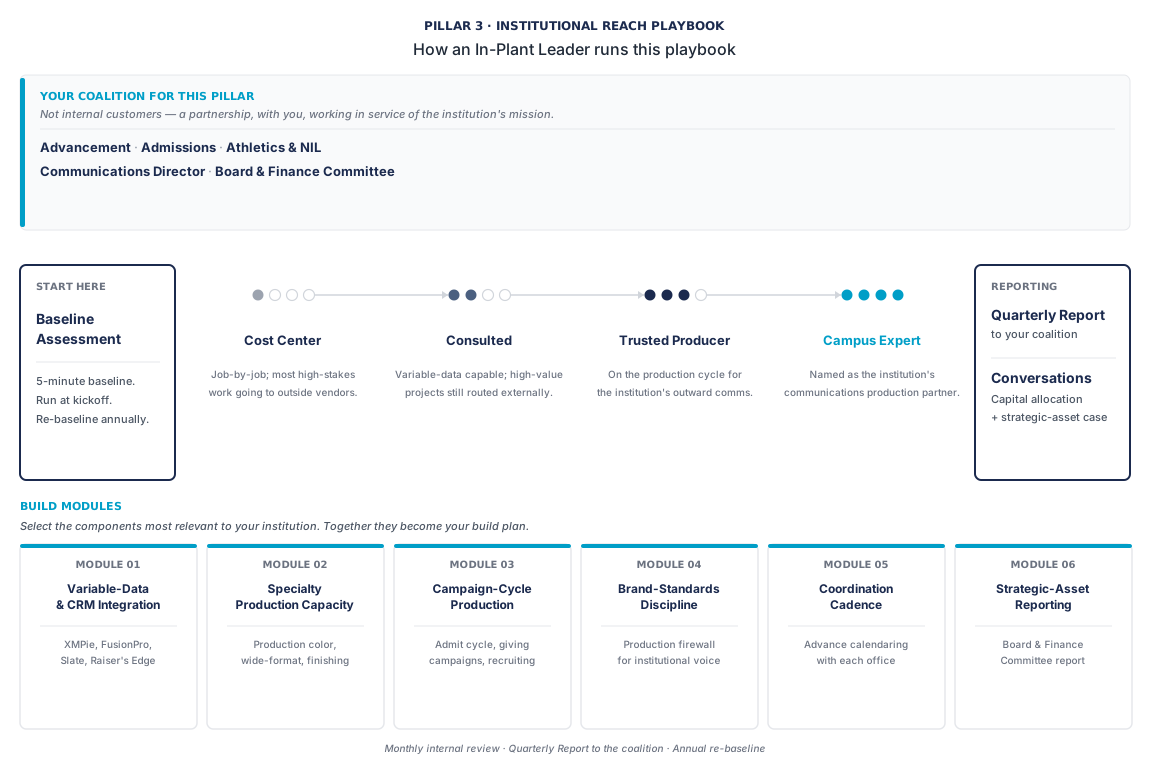
The whole playbook in one view

Coalition partners, maturity arc, build modules, and reporting cadence. The detail follows below; this is the map.

Institutional Reach playbook diagram. Coalition: Advancement, Admissions, Athletics and NIL, Communications, Cabinet and Finance Committee. Maturity arc: Cost Center, Consulted, Trusted Producer, Campus Expert. Six build modules: Variable-Data and CRM Integration, Specialty Production Capacity, Campaign-Cycle Production, Brand-Standards Discipline, Coordination Cadence, Strategic-Asset Reporting. Cadence: Monthly internal review, Quarterly Report to the coalition, Annual re-baseline.

What it helps you prove

Institutional Reach is about the materials that carry the institution's voice outside the building.

In K-12, that may include parent communications, district newsletters, enrollment materials, community notices, event programs, school board materials, athletics pieces, foundation or alumni communications, and multilingual family communication.

In higher education, it may include admissions packets, viewbooks, financial aid updates, campus visit pieces, alumni appeals, capital campaign materials, donor recognition, athletics recruiting collateral, event signage, commencement materials, and institutional reports.

The work varies by institution. The underlying question is the same: can the in-plant help the institution communicate with more speed, quality, control, and accountability than the outside alternative?

This playbook helps you answer four practical questions:

  • Which outward-facing work should the shop own or support?
  • How much of that work is currently leaving the institution?
  • What does the in-plant produce faster, more consistently, or more cost-effectively?
  • What capability or workflow would help the shop capture the next meaningful slice of work?

The goal is not to claim every outward-facing job belongs in-house. The goal is to identify the work where the in-plant gives the institution an advantage: faster timing, better version control, lower unit cost, stronger brand consistency, cleaner data handling, or more flexible production.

Where to focus first

Start with the work that represents the institution.

Not every print job carries the same institutional weight.

A routine internal handout and a capital campaign case statement may both move through the same production floor. They do not carry the same consequence. A classroom packet and an admit packet may both be student-facing. They belong to different conversations.

This playbook focuses on outward-facing work that helps the institution reach, persuade, inform, or deepen trust with external audiences.

Start by sorting the work into a few useful categories:

  • Admissions, enrollment, and yield
  • Advancement, donor, alumni, and foundation communication
  • Athletics, recruiting, and event experience
  • Parent, family, and community communication
  • Institutional brand, executive, and public-facing materials

Then identify what is produced in-house, what goes outside, what is handled inconsistently, and what no one has mapped yet.

That map becomes the basis for the conversation. It shows where the shop already supports institutional reach and where the next opportunity sits.

The Institutional Reach scorecard

The metrics most likely to matter in an Institutional Reach conversation.

These are practical enough to baseline and strong enough to support a capital, workflow, or vendor consolidation discussion.

If you take one number forward this quarter, take in-plant share of institutional outward-facing volume. It anchors every other strategic-asset conversation with a board-quotable share figure and a defensible dollar comparison to commercial vendors.

The institutional reach rows of the Outcomes Scorecard, plus four that measure outward-facing campaign work specifically. Use these as your quarterly baseline for the advancement, admissions, athletics, communications, and finance committee conversations.
Metric What it shows How to use it
In-plant share of outward-facing print volume How much institutional communication the shop produces compared with outside vendors Start with visible spend and known job categories. Even a partial baseline identifies recovery opportunities.
Variable-data campaign response uplift (strategic-asset metric) Response rate on personalized cultivation, segmented recruitment, or named-fund pieces versus a generic baseline. The 3–5× personalization uplift is the rhetorical number; the institution-specific figure is what travels. Track at the campaign level. Pair the variable-data system's record count with the advancement or admissions CRM's response and dollar outcome for board-quotable language.
Yield correlation on admissions touchpoints Matriculation rate among admits who received the full in-plant-produced packet sequence versus a reduced sequence. The single most board-quotable metric available on the admissions side. Requires admissions to share matriculation outcomes by cohort, segmented by communication sequence. Build this partnership with the Admissions Director before the May 1 cycle; pull the data after it closes.
Time-to-mail on priority institutional work Median hours from submission of a high-priority piece to the moment it enters the mail stream or reaches the recipient. Timestamp portal submission and mail-out events. Report median by submitting office. Commercial vendors cannot match same-day or next-day capability; this is what closes the timeline business case.
Brand standards adherence (strategic-asset metric) Percentage of outward-facing jobs produced to documented brand standards — color values, typography, paper stock, finishing, accessibility specs. Audit a quarterly sample against the Brand Standards document. Track by submitting office; brand drift typically concentrates in offices that bypass the in-plant for outside vendors.
First-time-right on visible institutional pieces Percentage of outward-facing jobs — admit packets, viewbooks, campaign cases, NIL collateral, event programs — produced correctly on the first run, no reprint. Track reprints by job category and tag by cause: file side, spec side, equipment side. Reprint cost on institutional work is the dollar figure that lands hardest in a Finance Committee conversation.
Donor response rate by personalization tier Response rate on cultivation pieces by tier: generic mass, segmented, individually personalized. The personalization tier delta justifies continuing investment in variable-data composition and CRM integration. The advancement CRM reports response rate by mail wave; the variable-data system reports record counts by tier. The delta is the proof point the Advancement Director takes to the board's development committee.
Peak window performance On-time and first-time-right rates during the institution's three highest-stakes outward-facing windows: typically the admissions yield window, the calendar year-end giving cycle, and commencement or capital campaign launch. Compare peak window metrics to baseline. Document the plan that produced the result. Carry it forward year over year with deltas annotated.

If you only track three numbers this quarter, start with in-plant share of outward-facing volume, time-to-mail on priority pieces, and cost comparison against outside vendors. Together they show how much work the shop currently owns, how quickly it can respond, and where the financial case is strongest.

What each coalition cares about

Your coalition does not measure this work in first-time-right rate.

Each chair measures it in whether the cycle moved on time, whether the pieces landed in the rooms that matter, and whether the institution looked like itself in the moment. The translations below map each coalition member's actual evaluation — and the conversation you will need to hold.

Filter by chair

Advancement

Advancement / Development Director — donor cultivation and capital campaign

For advancement, the question is whether the shop can support donor communication with enough quality, timing, and personalization to be trusted during campaign work.

A donor appeal, capital campaign case, reunion giving piece, impact report, named-fund recognition piece, or foundation mailing has to feel intentional. The production standard matters because the relationship matters. The Advancement Director knows the 30 to 75 times alumni direct mail response advantage over email; she knows the 3 to 5 times personalization uplift; she has seen what happens to a campaign budget when the personalized cultivation work goes to commercial vendors at retail unit cost and retail minimum runs.

What she does not always know is whether her in-plant can produce the personalized cultivation work she wants to run at the cadence her campaign cycle demands.

The question she is actually asking: Can my in-plant produce the personalized cultivation work I need to run, at the cadence my campaign cycle demands, at a unit cost that lets me keep the response uplift inside my campaign budget rather than spending it on commercial vendor markup?

Common objections or skepticism: "Our last variable-data campaign went outside because the in-plant couldn't pull the data from Raiser's Edge fast enough." / "The major-gift cultivation pieces have always gone to a high-end commercial printer because nobody trusted the in-plant on color." / "Our annual fund appeal lead time is two months because we can't get the personalized work turned around inside that window."

Proof points:

  • Variable-data campaign response uplift in dollars on a recent in-plant-produced campaign, paired with the unit economics comparison to the commercial vendor alternative
  • Donor response rate by personalization tier on a recent cultivation wave: generic mass versus segmented versus individually personalized, with dollar deltas attached
  • Time-to-mail on rush cultivation work (target: under 72 hours from data export to mail-out for personalized appeals)
  • The CRM integration approach with Raiser's Edge or Salesforce Education Cloud — which fields the in-plant can pull, what data handling discipline governs the file, what the turnaround looks like on a typical campaign
  • A standing offer to be in the three to five-year capital campaign planning conversation, with production capability and capacity reserved against the campaign roadmap

What to bring: The advancement-tagged scorecard. A variable-data composition sample portfolio — a recent named-fund piece, a segmented annual fund appeal, a capital campaign case. The unit cost comparison on a representative cultivation piece against the commercial vendor alternative. The CRM integration roadmap with current state and target state named.

Admissions

Admissions / Enrollment Management Director — yield, matriculation, and the close

For admissions, the question is whether the shop can help materials arrive during the decision window.

Yield is decided at the kitchen counter, not in the inbox. The Admissions Director runs an enrollment funnel where every stage has a print piece doing closing work: the viewbook a family receives during the search stage, the admit packet that arrives within 48 hours of a decision, the financial aid letter that updates a scholarship before May 1, the visit follow-up packet a family carries home after an official campus visit. Each piece has a window; outside that window, it is mail the family already had a chance to react to.

The question she is actually asking: Can my in-plant land every admit packet wave inside its closing window, at the production quality that signals institutional seriousness, on the variable-data infrastructure that lets me segment the way my admissions CRM lets me segment the audience?

Common objections or skepticism: "We had to send the financial aid update letters outside last spring because the in-plant couldn't turn them around inside the May 1 window." / "The viewbook print run goes to a commercial vendor because the volume doesn't fit our in-plant's standard workflow." / "Our CRM exports break the in-plant's import in ways nobody has time to fix every cycle."

Proof points:

  • Time-to-mail on admit packets and financial aid updates, with the trend over the last four cycles
  • First-time-right on visible admit packet work and the reprint cost avoided, with dollar figure attached
  • The CRM integration approach — which exports the in-plant ingests, what the turnaround looks like in a yield cycle wave, the field mapping that governs the personalization
  • A standing offer to partner on the matriculation data outcome — admits who received the full versus reduced communication sequence, with the matriculation rate delta as the headline number
  • The peak readiness plan for the May 1 yield window: capacity reservation, staffing, escalation paths, parallel run sequencing

What to bring: The admissions-tagged scorecard. A sample admit packet sequence from the most recent yield cycle, with time-to-mail data attached. The CRM integration roadmap with current and target state. The peak readiness plan for the upcoming May 1 window. If the matriculation data partnership is in place, the rate delta on the most recent cohort.

Athletics / NIL

Athletics Director / NIL Coordinator — recruiting infrastructure and the official visit

For athletics, the question is whether the shop can help the institution show up well during recruiting, events, and high-visibility moments.

The NIL era restructured college athletic recruiting. Schools without Power Five name-image-likeness budgets cannot win on NIL money alone, and the departments that figured this out early reorganized their recruiting work around the parts of the experience they still control. The official visit is the close. The recruiting packet a prospective athlete and her family carry home keeps doing closing work for days and weeks afterward. The Athletics Director knows her department's budget is scrutinized; what she wants is a recruiting infrastructure partnership that produces the personalized experience without the commercial vendor retail price.

The question she is actually asking: Can my in-plant produce the recruiting infrastructure my coaches need — the personalized official visit packet, the wide-format facility presence, the follow-up that keeps doing closing work after the recruit goes home?

Common objections or skepticism: "Our coaches send the recruiting work to a regional commercial printer because the in-plant's wide-format options are limited." / "The facilities banners are produced outside because nobody on our side thought to ask the in-plant." / "Our recruiting CRM exports don't talk to the in-plant; coaches mail merge their own scholarship letters."

Proof points:

  • Time-to-mail on official visit follow-up packets (target: under 48 hours from visit conclusion to mail-out, with the variable-data sequence in place)
  • The wide-format capability summary: in-plant cost per square foot on banners and facility wraps versus the regional commercial print alternative at the athletic department's volume
  • The recruiting CRM integration approach — what the integration looks like, data discipline on student-athlete records, the turnaround on a recruiting packet wave
  • A standing offer to be at the recruiting operations planning table by sport, with capacity reserved against the recruiting calendar
  • The cost comparison on a representative recruiting packet against the commercial vendor alternative at the department's annual volume

What to bring: The athletics-tagged scorecard. A sample recruiting packet from the most recent recruiting cycle, with variable-data and time-to-mail data attached. The wide-format capability summary and cost per square foot comparison. The CRM integration roadmap. The annualized cost comparison on the department's currently outsourced recruiting work versus the in-plant alternative.

Communications

Communications / Marketing Director — brand standards and integrated campaigns

For communications, the question is whether the in-plant can be the production firewall that holds the institution's brand standards consistently across every office that submits.

The Communications Director is the brand's institutional firewall. Her job is to make sure everything the institution puts in front of an external audience looks like the institution. Every piece — the viewbook produced by admissions, the campaign case produced by advancement, the recruiting collateral produced by athletics, the commencement program from the President's office — is a brand asset whose production quality either honors the brand or contributes to drift. Her single biggest operational pain is brand drift through commercial vendors whose press calibration, paper inventory, and finishing capability vary in ways the institution cannot control. Her single biggest operational win is an in-plant that holds the brand standards reliably across every submitting office.

The question she is actually asking: Can my in-plant be the production firewall that holds the institution's brand standards consistently across every office that submits, so that the brand drift I currently fight on commercial vendor work goes away on the work I route inside?

Common objections or skepticism: "The color on the in-plant's last admit packet run was off-brand; the cyan was wrong." / "Every commercial vendor calibrates differently; I cannot get a consistent brand experience across the four vendors I'm currently using for outward-facing work." / "I don't have a brand standards adherence number for the in-plant the way I do for our two largest commercial vendors."

Proof points:

  • The brand standards adherence audit results for the most recent quarter, segmented by submitting office, with the brand drift incident count attached
  • The press calibration cadence on the production color platform (target: weekly G7 calibration or equivalent, with documented results)
  • The certified paper stock inventory held against the institution's brand standards — text and cover stocks, paper weights, finishes
  • The accessibility specifications discipline built into the in-plant's standard intake
  • A standing offer to be the Communications Office's first-call partner for any outward-facing work currently routed to a commercial vendor, with brand standards adherence and on-time rate uplift modeled

What to bring: The communications-tagged scorecard. The brand standards adherence audit (most recent quarter). A representative work sample from each submitting office, scored against brand standards, with brand drift incidents named openly. The press calibration log. The certified paper stock inventory list.

Cabinet / Finance Committee

President / Cabinet / Board Finance Committee — strategic-asset translation

For finance and senior leadership, the question is whether the in-plant is a strategic asset or a cost line that has not been fully explained.

This conversation is rarely entered directly by the IPL — it is almost always carried in by a sponsor: the CFO, the VP for Finance and Administration, the Chief Operating Officer. It is also the conversation where the in-plant either earns a multimillion-dollar capital allocation across the next strategic-plan cycle or watches its budget line get reviewed item by item at the next Finance Committee meeting. The board does not need to understand Fiery preflight or wide-format inkjet economics. The board needs to understand that the institution's outward voice runs through the in-plant or it runs through commercial vendors at three to five times the cost and weeks of slip.

The question the room is actually asking: Is the in-plant a strategic asset of the institution, and if so, what is the capital and operational commitment that turns it from a cost center function into a competitive differentiator at our volume?

Common objections or skepticism: "We can outsource print at lower margins to a regional vendor; explain why we should keep this in-house." / "The capital request on the production color refresh is competing against the residence-hall renovation request; why is this the higher-priority strategic investment?" / "We don't see the in-plant in the institution's reach strategy; show us where it should be."

Proof points:

  • In-plant share of institutional outward-facing volume — the headline strategic-asset number — with the trend over the last three to five years and the share recovered from commercial vendors in the most recent period
  • Variable-data campaign response uplift in dollars on a recent campaign, with the campaign budget protection narrative attached
  • Yield correlation on admissions touchpoints — admits who received the full versus reduced communication sequence, with the matriculation rate delta and enrolled-student dollar value attached
  • The unit economics comparison on representative outward-facing work at the institution's volume: in-plant unit cost versus commercial vendor unit cost, with the institutional spend implication modeled
  • The capital allocation request paired with the payback period, the share recovery the capacity unlocks, and the brand standards and on-time uplift modeled

What to bring: The strategic-asset quarterly report (in-plant share of outward-facing volume, variable-data response uplift in dollars, yield correlation, time-to-mail, brand standards adherence). The unit economics comparison on representative work. The capital allocation request with payback and share recovery modeling. The strategic-plan alignment narrative, named clearly. The CFO sponsor's name on the cover memo; the IPL does not walk into the Finance Committee unsponsored.

The maturity path

Where your shop stands today.

Use this maturity model to place your current Institutional Reach work honestly. The leap that produces a different conversation at budget time is Level 2 → Level 3 — the move from "we can run that work" to "we are on the cycle that runs that work." The leap that changes the institutional conversation is Level 3 → Level 4 — the move from production partner to strategic asset.

Level 1
Cost Center
The shop runs work on request. It isn't part of the cycle.
Read the full description
The shop produces outward-facing work when an office asks, but it is not part of the planning cycle. Admissions, advancement, athletics, communications, and events may use the shop for some jobs and outside vendors for others — often out of habit, timing, perceived quality, or simple lack of awareness. Variable-data composition is either absent or limited to mail merge. The shop runs the work it receives; it is not on the institution's calendar; its share of the institution's outward-facing print spend is a fraction of what that spend actually is.
Level 2
Consulted
The capability is there. The planning handoff isn't.
Read the full description
The shop has meaningful capability for outward-facing work — quality color, booklets, mailings, event materials, signage, segmented pieces. Some offices know this. The advancement office has started to test it. The athletics department still sends recruiting work outside because no one has built the official visit window workflow. The shop can support institutional reach, but it is brought in too late or too inconsistently. The business case exists in scattered examples rather than a measured pattern.
Level 3
Trusted Producer
On the calendar. In the workflow. Part of the cycle.
Read the full description
The shop is on the institutional calendar. Admissions, advancement, athletics, communications, and events share upcoming work early enough for the shop to reserve capacity, prepare templates, plan materials, and reduce last-minute workarounds. Variable-data composition runs as the default for cultivation, recruitment, and personalized institutional work; CRM integration with the admissions and advancement systems is automated or near-automated. In-plant share of institutional outward-facing volume is measured and reported quarterly. Brand standards adherence is audited and tracked by submitting office.
Level 4
Campus Expert
The in-plant is part of how the institution plans for its future.
Read the full description
Capital expenditure decisions on production equipment — high-end production color, wide-format inkjet, finishing infrastructure, mailing operation — are made against the institution's outward-facing reach roadmap, not against equipment refresh cycles alone. The President's Cabinet treats the in-plant as part of the institution's strategic enrollment, advancement, and brand equity infrastructure. The Finance Committee receives quarterly strategic-asset reporting alongside enrollment and advancement reporting. The advancement office's three to five-year campaign roadmap includes the in-plant as a planning participant. The board recognizes the in-plant as a competitive differentiator at the institution's volume.
Most shops live at Level 1 and aspire to Level 2 on outward-facing work, even when they are at Level 3 or 4 on student materials and educator capacity work. The institutional reach side is the one most likely to be siphoned to commercial vendors before the in-plant ever sees it. The move that changes that conversation is Level 2 to Level 3 — from "we can run that" to "we are planned into the cycle that needs it."

The build-out

The six tracks of an Institutional Reach build-out.

These tracks are sequenced in the order most shops can act. Tracks 1, 3, 4, 5, and 6 are workflow and reporting disciplines that run on existing equipment plus software and process investment. Track 2 is the equipment decision track, and it is where the strongest capital business cases concentrate — because the institution's outward voice is where production quality earns the strongest unit economics advantage over commercial vendors.

01
Variable-data workflow and institutional CRM integration
Make personalized the default; make integration reliable.
Read the full description

This track builds the personalization infrastructure that makes the in-plant genuinely useful during admission, cultivation, and recruiting cycles. The goal is to move variable-data composition from a special-project capability to the standard production default for recurring institutional work — annual fund appeals, segmented cultivation pieces, admit packet personalization, scholarship letter automation, recruiting packet personalization, parent communications by household language and program. The other half of the track is integration: automated or semi-automated data handoffs from the institution's advancement, admissions, and athletic recruiting systems, with clear data handling discipline that lets those offices send the in-plant the files they would otherwise hesitate to send. This is the track that turns the in-plant into the production partner advancement and admissions actually need during a campaign cycle.

Measure: variable-data campaign response uplift, donor response rate by personalization tier, share of total outward-facing volume produced as personalized work.

02
Specialty production capacity — high-end color, wide-format, finishing
Match the production capacity to the institution's outward-facing visibility.
Read the full description

Three capacity decisions concentrate the business case here: a production color press for high-quality short and medium run institutional work; a wide-format inkjet platform for banners, signage, event collateral, and the wide-format work that NIL era athletic recruiting demands; and finishing infrastructure at a configuration the institution's outward-facing pieces actually need. The business case for each follows the same shape: in-plant unit cost on a representative outward-facing job versus the commercial vendor unit cost at the institution's actual volume, payback period, the share recovery the capacity unlocks, and the on-time and brand standards uplift that comes with bringing the work inside. This is the equipment decision track. The IPL who can present this case in board-quotable terms is the one who walks out of the Finance Committee with capital allocation.

Measure: production color cost per impression delta versus commercial vendor, wide-format cost per square foot delta, finishing capability gap closure on specific outward-facing jobs, in-plant share recovery on outward-facing volume.

03
Campaign-cycle production planning
Get on the calendar before the cycle starts.
Read the full description

This track replaces reactive order-taking with standing production planning across the four primary submitting offices. Advancement shares the annual fund calendar, quarterly mailing waves, and the three to five-year capital campaign roadmap. Admissions shares the application-to-matriculation cycle with mailing waves at search, application, admit, financial aid, visit, and yield stages. Athletics shares the recruiting calendar by sport, including official visit windows and signing days. Communications shares commencement, capital campaign launch, and major institutional event windows. For each cycle, the shop reserves capacity against peak windows, documents the peak readiness plan in writing, and reviews actuals against plan after the cycle closes. The plan carries forward year over year with deltas annotated.

Measure: peak window on-time rate and first-time-right rate, calendar integration completeness, capacity reservation accuracy.

04
Brand standards production discipline
Make the in-plant the brand's production firewall.
Read the full description

This track establishes the operational discipline that lets the in-plant do what commercial vendors cannot consistently do: hold the institution's brand standards reliably across job types, paper stocks, and production runs. That means a documented press calibration cadence on the color platform, certified paper stocks held in inventory against the brand standards, finishing recipes documented and reproducible across operators, and accessibility specifications built into the standard intake workflow. The payoff is a quarterly brand standards adherence audit that the IPL can publish to the Communications Director — showing which offices are producing on-brand and where drift is concentrating. Most commercial print vendors cannot match this. The in-plant can, and the Communications Director's biggest operational pain becomes the shop's strongest argument.

Measure: brand standards adherence rate by submitting office, brand drift incidents, Communications Office referral rate.

05
Coordination cadence with advancement, admissions, athletics, and communications
Be in the room before the work is committed.
Read the full description

This track builds standing monthly or quarterly planning conversations with each of the four primary submitting offices. These are not status meetings on jobs in flight. They are planning conversations about the next cycle's work, upcoming campaign milestones, equipment and capacity decisions the in-plant is considering, and capabilities the office wishes the shop had. The advancement office's campaign roadmap should be visible to the in-plant. The admissions CRM segmentation strategy should be visible. The athletics recruiting calendar by sport should be visible. The communications brand evolution roadmap should be visible. Getting into these conversations before the work is committed is what separates a Trusted Producer from a shop that finds out about the viewbook deadline three weeks before it ships.

Measure: cadence completion rate, share recovery decisions made out of the cadence, in-plant-suggested capability investments approved.

06
Strategic-asset reporting to the Cabinet and Finance Committee
Translate, don't just track. The metric the room wants is institutional return.
Read the full description

This track builds the reporting that travels to the President's Cabinet, the Board Finance Committee, and the Trustees' development or advancement committee — quarterly to the CFO and Cabinet, annually to the Finance Committee, and on demand into the capital campaign reporting cadence. The headline metrics are in-plant share of outward-facing volume, variable-data campaign response uplift in dollars, yield correlation on admissions touchpoints, brand standards adherence, time-to-mail on priority work, and peak window performance against plan. The narrative is the in-plant's role as the production engine for the institution's reach work — the share recovered from commercial vendors in the period, the dollar value, and the capability roadmap that would close the remaining outward-facing volume the institution still spends outside.

Measure: per-room reporting cadence completion, capital allocation decisions made from the strategic-asset report, the in-plant's position in the institution's strategic plan document.

The 90-day baseline

Choose one outward-facing workflow and baseline it for 90 days.

Good starting points include: admit packets or enrollment materials, a donor or alumni mailing, a parent or family communication sequence, athletics event materials or recruiting pieces, commencement or open house materials, a district or campus community communication package, or a recurring board or cabinet report.

Track: who owns the communication, what audience receives it, whether it was produced in-house or outside, cost per piece or total production cost, time from approved file to delivery or mail, whether the job required rework, whether the piece met brand and accessibility expectations, and what would need to change for the shop to own more of this work next cycle.

At the end of the 90 days, write a one-page summary:

  • What workflow we tracked
  • What the shop produced
  • What went outside
  • What the timing and cost showed
  • What friction slowed the work down
  • What capability or planning change would improve the next cycle
  • What decision is needed from the stakeholder group

That one page is the beginning of the strategic-asset conversation.

In coalition conversations

How to use this in coalition conversations.

Do not lead with the full shop. Lead with the work the coalition already cares about.

For advancement, bring the donor or campaign example. For admissions, bring the yield window or enrollment example. For athletics, bring the event, signage, or recruiting example. For communications, bring brand-sensitive samples. For finance, bring outside spend and the representative cost comparison.

Use the same conversation structure each time: here is the work we tracked, here is what stayed inside and what went outside, here is the timing or cost or brand issue we found, here is what the shop can improve now, here is the decision or planning change we need next.

The best next step is specific: a pilot mailing, a template rollout, a brand-standard review, a recurring event package, a cost comparison, a planning cadence, or a capital business case tied to known outside spend. Keep the conversation close to the work. That is where the shop's value becomes visible.

Related playbooks

Where the conversation goes next.

Closing

Start with one outward-facing workflow.

You do not need to prove the full value of the in-plant in one quarter. Start with the work your institution already cares about — one admissions mailing, one donor appeal, one event package — and baseline it for 90 days. Learn where the process is strong and where it breaks. Translate the result for the coalition that needs to hear it.

Then decide what the next 90 days should prove.

That is how the shop moves from the vendor they call when something is late to the production partner the institution plans around.

FAQ

Frequently asked questions about Institutional Reach in education in-plants

The in-plant's strongest candidates are work where timing, brand consistency, data handling, or unit economics favor in-house production: admit packets, donor cultivation, recruiting collateral, parent communications, event programs, and commencement materials. The goal is not to claim every job belongs in-house, but to identify where the in-plant gives the institution an advantage over commercial vendors — faster timing, lower unit cost, stronger brand consistency, or cleaner data handling.

The most actionable starting set is in-plant share of institutional outward-facing volume, time-to-mail on priority pieces, and cost comparison against outside vendors. From there, add variable-data campaign response uplift, brand standards adherence rate, first-time-right on visible institutional pieces, and yield correlation on admissions touchpoints. Together these metrics answer the questions admissions, advancement, athletics, communications, and Finance Committee leaders actually ask.

The business case for production color, wide-format, or finishing equipment follows a consistent shape: in-plant unit cost on a representative outward-facing job versus commercial vendor unit cost at the institution's actual volume, payback period on the equipment investment, the in-plant share recovery the capacity unlocks, and the on-time and brand standards uplift that comes with bringing the work inside. The IPL who can produce this case in board-quotable terms is the IPL who walks out of the Finance Committee with capital allocation.

The move from production vendor to strategic-planning participant requires two things: a quarterly strategic-asset report that travels to the CFO and Cabinet with board-quotable metrics (in-plant share of outward-facing volume, variable-data response uplift in dollars, yield correlation, time-to-mail), and a CFO or VP for Finance sponsor who carries the in-plant's capital request into the Finance Committee. The IPL does not walk into the Finance Committee unsponsored.

The in-plant's recruiting infrastructure argument is based on the parts of the recruiting experience the institution still controls after NIL: the personalized official visit packet, the wide-format facility presence during the visit, and the follow-up packet that keeps doing closing work after the recruit goes home. The in-plant can turn around personalized recruiting materials inside 48 hours of an official visit and produce facility banners and signage at a cost per square foot the athletic department can compare openly to the regional commercial print alternative.

Start the conversation

Make the in-plant visible as the production partner behind institutional reach.

One outward-facing workflow. One 90-day baseline. One translated result for the coalition that needs to hear it. That is enough to begin.

Bring the answer into the room before someone else frames the question.