
Enterprise IPL Playbook — Institutional & Outward-Facing Communications

The institution's outward voice runs through your shop. Or it runs through commercial vendors at three to five times the cost and weeks of slip.

Cultivation campaigns, brand production, proposals, brand-led recruitment. Bring the highest-value institutional communication inside.

Some communications do more than inform. They help someone choose, trust, fund, buy, visit, enroll, refer, approve, or continue the relationship.

Those are the pieces most likely to leave the building — to outside print vendors, specialty shops, mail houses, proposal vendors, or brand agencies. And when they go outside, two things happen on the same invoice. The per-piece cost runs three to five times what the in-plant would produce it for, because commercial vendors price institutional work at retail margins and minimum runs that don't match how an institutional cycle actually moves. And the lead time becomes weeks at the moments when the institution needs the work in days.

The donor whose ask was approved this morning. The patient whose decision window closes on Friday. The prospect who just took the visit. The bid that has to land on a board's desk by 5 PM Tuesday.

The cost-and-timeline math is one of the cleanest business cases an in-plant leader has available to her. This playbook helps you build it.

Start with one outward-facing workflow. Map who owns it, where it is produced, what it costs, how long it takes, and what would need to change for the in-plant to own more of it.

Playbook at a glance

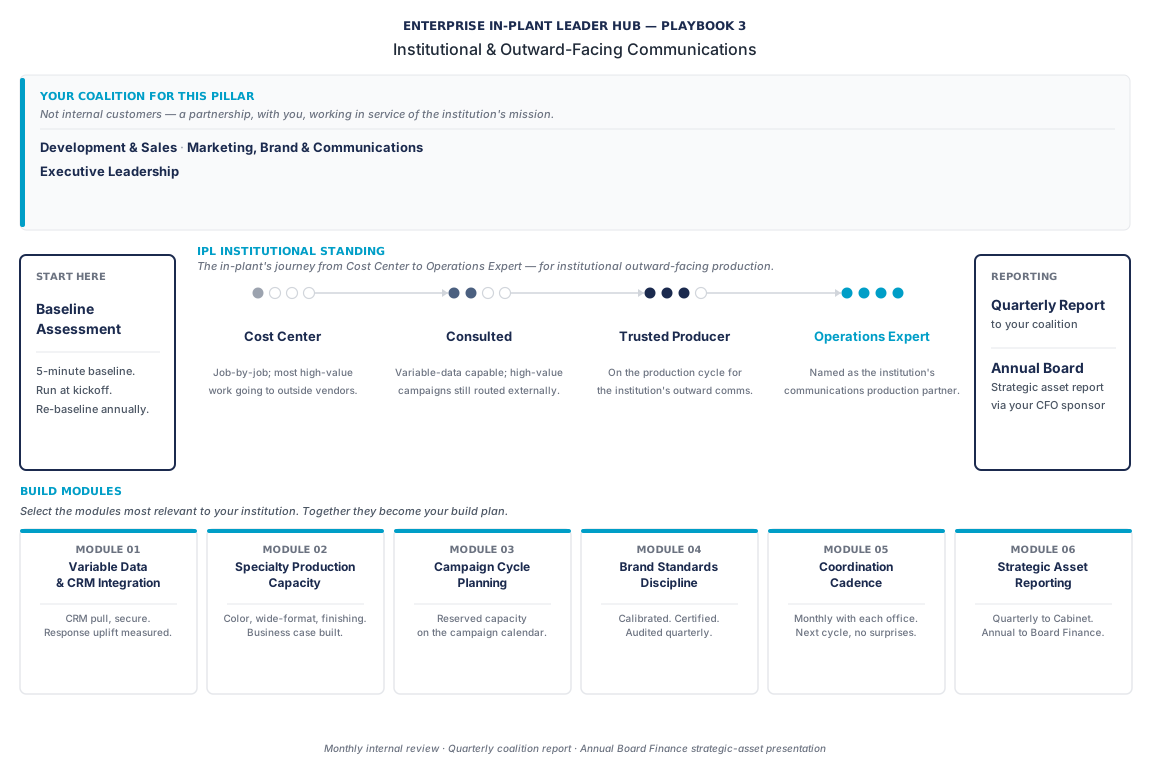
The whole playbook in one view

Coalition partners, maturity arc, build modules, and reporting cadence. The detail follows below; this is the map.

Institutional & Outward-Facing Communications playbook diagram. Coalition: Development and Sales, Marketing and Brand, Executive Leadership. Maturity arc: Cost Center, Consulted, Trusted Producer, Operations Expert. Six build modules: Variable-data and CRM integration, Specialty production capacity, Planning cadences with outward-facing offices, Brand-production standards, Templates for recurring visible pieces, Strategic-asset report.

What it helps you prove

Institutional and outward-facing communications shape how people experience the organization before, during, or after a major decision.

The vertical context may change. In healthcare or senior living, the work may support patient, resident, or family decision-making. In nonprofit work, it may support donor trust and constituent engagement. In commercial B2B, it may support sales, proposals, recruiting, events, or brand-led campaigns.

The playbook helps answer five practical questions:

  • What outward-facing work is the organization already producing?
  • How much of it is produced in-house?
  • How much leaves for outside vendors?
  • What is the cost, timing, quality, and brand-control difference?
  • What capability or planning change would help the shop capture the next meaningful slice?

The goal is to use real work to build the case.

Where to focus first

Start with the work that already goes outside.

Do not start with a capital request.

Start with a real workflow. Choose a recurring outward-facing job that has visible cost, timing pressure, quality expectations, or brand sensitivity. Then compare the current outside path with the in-plant path.

The strongest business case usually comes from work that repeats. A repeated job creates enough volume to compare, enough familiarity to improve, and enough future opportunity to justify planning.

The Institutional & Outward-Facing scorecard

The metrics most likely to matter in an outward-facing conversation.

The number that travels furthest to executive leadership is in-plant share of institutional outward-facing volume. It is the metric that anchors every other strategic-asset conversation — every point of share recovered from outside vendors is a unit-economics win leadership can quote. The harder lift, and the more strategic one, is audience-cycle correlation: the outcome rate among recipients who received the full in-plant-produced communication sequence. Once you have it, the outcome-rate delta is the most board-quotable metric an in-plant ever brings to the table.

Eight metrics for the outward-facing conversation. Use them as your quarterly baseline for development, sales, marketing, brand, and executive-leadership conversations.
Metric What it shows How to use it
In-plant share of outward-facing volume How much high-value communication work the shop produces compared with outside vendors Start with known spend and visible job categories. Audit annually by office and by category.
Cost comparison against outside vendors Whether the in-plant can produce representative work at better value Compare unit cost, setup fees, rush fees, shipping, minimums, and reprint exposure. The commercial-vendor cost at retail is the anchor for every budget conversation.
Time-to-mail or time-to-delivery How quickly the shop can move approved work into the recipient's hands Use this for decision-window or campaign-window work. Commercial vendors cannot beat the in-plant's same-day or next-day capability on rush institutional pieces.
Variable-data response uplift Response rate on personalized cultivation, segmented audience-acquisition, or named-relationship pieces versus the generic baseline The 30-to-75-times direct-mail response advantage over email and the 3-to-5-times personalization uplift are the rhetorical numbers. The institution-specific uplift is what travels to leadership. Pair with response-dollar-size on the same segment.
First-time-right on visible pieces Whether outward-facing work is correct on the first run Track reprints by category and cost. A reprint on a cultivation piece or a strategic-bid package is a strategic problem, not a workflow problem.
Brand-standards adherence Whether outward-facing materials hold approved production standards Review a quarterly sample with Marketing or Communications. Score on color accuracy, typography, stock, finishing, accessibility.
Response or outcome comparison Whether a communication sequence appears connected to response, close, gift, referral, visit, or conversion outcomes Build the data partnership first. Use cautiously and report only what the data supports.
Peak-window performance Whether the shop holds timing and quality during the cycles that matter most Use the organization's real calendar — cultivation cycles, campaign milestones, proposal windows.

If you only track three items this quarter, start with in-plant share of outward-facing volume, cost comparison, and time-to-delivery. Those three make the first conversation concrete.

What each coalition partner cares about

Three rooms. Three translations. One body of work.

Each coalition partner measures outward-facing work in different terms — pace and unit cost, brand consistency, or strategic-asset return. The translations below map what each one is actually asking and what to bring to the conversation.

Filter by chair

Development / Sales

Development, sales, or audience acquisition

This partner cares whether the shop can produce communication work at the pace and quality the cycle requires.

In healthcare: Foundation Director / Chief Development Officer or Patient Acquisition Director. In senior living: Resident Family Engagement Director or Resident Recruitment Director. In nonprofit: Development Director / Major Gifts Officer, plus Constituent Acquisition Director. In commercial B2B: Business Development Director, Proposal Capture Manager, or the named-account executive who owns a multi-million proposal.

The question she is actually asking: can my in-plant produce the personalized work I need to run, at the cadence my cycle demands, at a unit cost that lets me keep the response uplift inside my budget rather than spending it on commercial-vendor markup? She has board reporting on response or close rate. What she does not always know is whether her in-plant can run the personalized work she wants at the cadence her cycle demands.

What to bring: one representative job, the outside cost, the in-plant cost, the timeline comparison, and the next-cycle opportunity.

Marketing / Brand

Marketing, brand, and communications

This partner cares whether the shop can be the production firewall that holds the institution's brand standards consistently across every office that submits.

In healthcare: Chief Marketing Officer or Communications Director. In senior living: Director of Marketing. In nonprofit: Communications Director. In commercial B2B: Chief Marketing Officer, VP of Brand, or the marketing lead inside a firm that owns brand-led campaigns.

She knows the production-quality variability across the commercial vendors the institution is currently using. What she does not know is whether the in-plant has the press-calibration discipline, the certified paper-stock inventory, the finishing capability, and the accessibility-specifications discipline to be the brand's production firewall. Brand drift that she currently fights on commercial-vendor work goes away on the work she routes inside.

What to bring: brand-standards adherence rate by submitting office, first-time-right on visible institutional pieces, and samples with clear before-and-after quality evidence.

Executive Leadership

Executive leadership

Executive leadership cares whether the in-plant is a strategic asset of the institution or a back-office function that has not yet been outsourced.

In healthcare: C-Suite plus Board Quality and Finance Committees. In senior living: Owner / CEO / Investor Board. In nonprofit: Board and Executive Director. In commercial B2B: Executive Committee or Ownership Group.

This is the conversation the IPL is rarely in directly and is almost always carried into by a sponsor — typically the CFO, VP for Finance and Administration, or Chief Operating Officer. The translation that lands in this room treats the in-plant as the production engine for the institution's outward-facing work and quantifies that work in board-quotable terms: in-plant share of institutional outward-facing volume, variable-data response uplift in dollars, brand-standards adherence as a brand-equity protection metric, and the unit-economics comparison to the commercial-vendor alternative at the institution's actual volume.

Equipment comes later, tied to a defined body of recurring work. Do not lead with equipment in this room.

What to bring: in-plant share of outward-facing volume, outside vendor spend, representative cost comparison, timing difference, and the capability gap that prevents the shop from owning more of the work.

The maturity path

Where your shop stands today.

The move that changes the budget conversation is Level 2 to Level 3. The move that changes the institutional conversation is Level 3 to Level 4.

Level 1
Cost Center
Outward-facing work comes in ad-hoc — the shop runs what it receives, not what the institution sends out.
Read the full description
Outward-facing institutional work comes into the shop on an ad-hoc basis. Variable-data composition is either absent or limited to mail-merge. The shop runs the work it receives. It is not on the institution's outward-facing calendar. Its share of institutional outward-facing spend is a fraction of what the spend actually is.
Where most shops live today
Level 2
Consulted
The capability exists but the strategic work still routes outside — the unit-economics case isn't yet documented.
Read the full description
The shop has variable-data composition capability and can run personalized work at production speed. The offices know the capability exists but route most strategic work outside. CRM integration is partial or hand-off-based. The unit-economics conversation is winnable but has not yet been documented.
The move that changes the conversation
Level 3
Trusted Producer
The shop is reserved against the institution's outward-facing calendar and reports brand-standards adherence quarterly.
Read the full description
The shop is reserved against the institution's outward-facing calendar — cultivation cycles, audience-acquisition waves, brand-campaign milestones, business-development windows. Variable-data composition runs as the default for personalized institutional work. CRM integration is automated or near-automated. In-plant share of institutional outward-facing volume is measured and reported. Brand-standards adherence is audited.
Level 4
Operations Expert
Executive leadership treats the in-plant as part of strategic communications infrastructure.
Read the full description
Capital expenditure decisions on production equipment are made against the institution's outward-facing roadmap, not equipment refresh cycles. Executive leadership treats the in-plant as part of the institution's strategic communications infrastructure. The board recognizes the in-plant as a competitive differentiator at the institution's volume.

The build-out

Six build modules for Institutional & Outward-Facing Communications.

Modules 1, 3, 4, 5, and 6 are workflow and reporting disciplines. Module 2 is the equipment-decision module where the institution's strongest capital business cases concentrate — the institution's outward voice is where production-quality capital allocations earn their strongest payback. Select the modules most relevant to your institution.

01
Build variable-data capability and CRM integration
Deploy personalized composition at production scale with institutional-grade data handling.
Read the full description

Deploy variable-data composition (XMPie PersonalEffect, FusionPro Producer, or Fiery variable-data tools) at production scale. Build automated or semi-automated integration with the institution's CRMs over secure institutional channels. Build the data-handling discipline — HIPAA for healthcare, donor-data stewardship for nonprofits, named-account confidentiality for commercial B2B — that lets the offices send the data files they would otherwise hesitate to send.

Measure: variable-data campaign response uplift, response rate by personalization tier, and share of total outward-facing volume produced as personalized work.

02
Build specialty production capacity (the equipment-decision module)
Three capacity decisions concentrate the strongest business cases the in-plant brings to leadership.
Read the full description

Three capacity decisions concentrate the business case. A production color press (Kyocera TASKalfa Pro 15000c, Canon imagePRESS, Konica Minolta AccurioPress, or Ricoh Pro C tier) for short-and-medium-run institutional work. A wide-format inkjet platform (HP DesignJet Z-series, Canon imagePROGRAF, Epson SureColor) for banners, signage, event collateral, and recruitment displays. Finishing infrastructure (perfect-bind, saddle-stitch, scoring, folding, foil, die-cut) at a configuration the institution's outward-facing pieces actually need. Business case shape: in-plant unit cost vs. commercial-vendor unit cost at the institution's actual volume, payback period, share recovery, and the on-time and brand-standards uplift from bringing the work in-house. The IPL who can produce that business case in board-quotable terms is the IPL who walks out of executive leadership with capital allocation.

Measure: cost-per-impression and cost-per-square-foot deltas vs. commercial vendor, finishing capability gap-closure, in-plant share recovery on outward-facing volume.

03
Build planning cadences with the outward-facing offices
Move from status meetings to planning conversations about the next cycle's work.
Read the full description

Reserve production capacity against each cycle's peak windows. Document the peak-readiness plan. Review actuals against plan after each cycle and carry the deltas forward. A standing monthly or quarterly cadence with each of the primary submitting offices is the mechanism — not a status meeting on jobs in flight, but a planning conversation about the next cycle's work.

Measure: peak-window on-time rate, first-time-right rate, and capacity-reservation hit rate.

04
Establish brand-production standards
Become the brand's production firewall across every office that submits.
Read the full description

Document press-calibration cadence on the color platform. Hold certified paper stocks in inventory. Document finishing recipes. Build accessibility specifications into the standard intake. Publish the brand-standards adherence audit quarterly to the marketing-and-brand office.

Measure: brand-standards adherence rate by submitting office, brand-drift incidents, and marketing-and-brand office referral rate.

05
Create templates for recurring visible pieces
Outward-facing work repeats more often than it feels like it does — template it.
Read the full description

Outward-facing work repeats more often than it feels like it does. Build templates for the recurring pieces that carry brand, audience, or relationship value. Define approval, proofing, paper, finishing, versioning, and delivery requirements.

Measure: first-time-right rate and turnaround by template type.

06
Build the strategic-asset report
Translate shop performance into board-quotable terms that drive capital allocation.
Read the full description

Once the shop has real data, translate it for leadership. The headline metrics: in-plant share of institutional outward-facing volume, variable-data response uplift in dollars, brand-standards adherence rate, time-to-mail on rush institutional work, peak-period performance. Quarterly to the CFO or COO. Annually to the Board Finance Committee or equivalent in the strategic-plan reporting cycle. The report's job is to make the in-plant's contribution to the institution's outward work visible enough that capital allocation follows the evidence.

Measure: reporting cadence and capital-allocation decisions made off the strategic-asset report.

The 90-day baseline

Choose one outward-facing workflow and track it for 90 days.

Use this checklist:

  • Workflow owner
  • Audience
  • Current production path (in-house or outside vendor)
  • Cost
  • Turnaround
  • Rework or reprint
  • Brand standard result
  • Data handling if variable data is used
  • What would need to change next cycle

At the end of 90 days, write a one-page summary. Show what stayed inside, what went outside, what the comparison revealed, and what decision would improve the next cycle.

Related playbooks

Where the conversation goes next.

Frequently asked

Outward-facing communications — common questions.

In-plants can produce personalized cultivation pieces, donor and patient materials, recruitment displays, event collateral, wide-format signage, strategic proposals, and brand-led campaigns — the work most likely to leave the building for commercial vendors at three to five times the cost. The playbook helps identify which workflows are already going outside and build the case for bringing them in-house.

Start with one recurring outward-facing job that has visible cost, timing pressure, or brand sensitivity. Compare the current outside path with the in-plant path on unit cost, setup fees, rush fees, and lead time. Commercial vendors price institutional work at retail margins that don't match how an institutional cycle actually moves — the cost-and-timeline math is one of the cleanest business cases an in-plant leader has available.

Variable-data response uplift measures the response-rate advantage of personalized communication over generic output. Direct mail produces 30-to-75-times the response rate of email, and personalization adds a further 3-to-5-times uplift over the generic baseline. An in-plant running variable-data composition (XMPie PersonalEffect, FusionPro Producer) integrated with the institution's CRM turns that response advantage into a board-quotable dollar figure.

Start with three: in-plant share of institutional outward-facing volume (every point recovered from outside vendors is a unit-economics win leadership can quote), cost comparison against outside vendors, and time-to-mail or time-to-delivery. Once the data relationship with outward-facing offices is established, add variable-data response uplift and brand-standards adherence rate.

Three capacity decisions concentrate the business case: a production color press (Kyocera TASKalfa Pro 15000c, Canon imagePRESS, Konica Minolta AccurioPress, or Ricoh Pro C tier), a wide-format inkjet platform (HP DesignJet Z-series, Canon imagePROGRAF, Epson SureColor), and finishing infrastructure configured to the institution's actual pieces. Capital decisions should follow a documented body of recurring outward-facing work — not equipment refresh cycles.

Start the conversation

Bring the institution's outward voice back inside — one workflow at a time.

One outward-facing workflow. One 90-day baseline. One translated result for the coalition that needs to hear it. That is enough to begin.

Bring the answer into the room before someone else frames the question.