
Enterprise IPL Playbook — End-User Materials

Prove the shop's role in the materials people actually depend on.

Patient packets, resident move-in kits, aid-recipient materials, proposal packages. Prove the role your shop plays in the materials people receive, read, and rely on.

Every institution has a person at the end of its value chain. The person the institution exists to serve.

The patient managing her care at home after discharge. The senior living resident on her first day at the community her family selected. The aid recipient receiving services that may have taken months to access. The new employee receiving the onboarding set that will shape her first month. The board member opening a real-estate-development bid package on a Friday morning, in a meeting that will commit fifty million dollars.

The materials that person holds, reads, follows, or carries home are the materials whose quality, timing, format, and dignity decide whether the institution's mission shows up where it has to. That is the shop you run.

This playbook is how you run that work as a discipline. What to measure. Where the gaps usually sit. How to close them. How to translate the work for the people on your coalition who design and deliver what the end-user receives.

Start with one end-user material workflow. Track it for 90 days. Show timing, correctness, rework, and documentation. Then bring the result to the people who own the content, the experience, or the cost.

Playbook at a glance

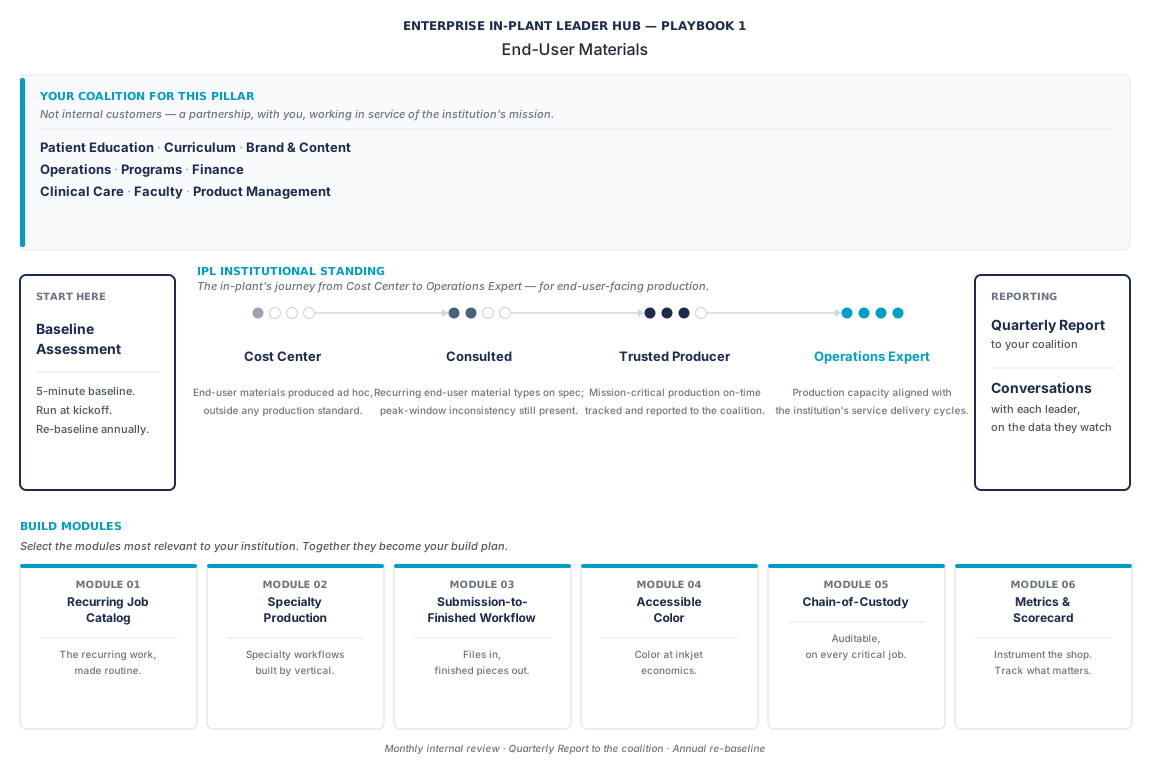
The whole playbook in one view

Coalition partners, maturity arc, build modules, and reporting cadence. The detail follows below; this is the map.

End-User Materials playbook diagram. Coalition: Content Owner, Affordability Leader, Practitioner Sponsor, Experience and Brand Owner. Maturity arc: Cost Center, Consulted, Trusted Producer, Operations Expert. Six build modules: Recurring material catalog, Specialty production workflow, Source-to-finished path, Color and finishing decisions, Mission-critical documentation, Coalition reporting cadence.

The work this proves

What this playbook helps you prove

End-user materials are the pieces that leave the organization and land with the person who has to use them.

The format may change by vertical — discharge packets in healthcare, move-in kits in senior living, intake packets in nonprofit work, proposal packages in commercial B2B — but the production question is the same: can the shop produce the material in the right format, on the right timeline, with the right quality and documentation?

This playbook helps answer four practical questions:

  1. Which end-user materials should be treated as mission-critical?
  2. How reliably are those materials produced on time and correct the first time?
  3. Where do files, specifications, approvals, or handoffs break down?
  4. What would it take to make the workflow easier to trust?

Mission-critical means the material has a real consequence if it is late, wrong, inaccessible, or unavailable — when timing, accuracy, accessibility, or delivery affects whether the person receiving it can use it as intended.

The starting frame

Start with one material people actually depend on

Choose one recurring end-user workflow.

In healthcare, that may be a discharge packet or patient education set. In senior living, it may be a move-in kit or family communication packet. In nonprofit work, it may be an intake packet or program manual. In commercial B2B, it may be a proposal package, onboarding set, or customer-facing field document.

Do not start with the full shop. Start with one workflow that matters enough for someone outside the shop to care about the result. Then document how the job moves from source content to finished material.

The scorecard

The End-User Materials scorecard

The number that travels furthest is mission-critical on-time rate. The end-user coalition does not benchmark overall on-time against anything in the abstract. They remember the week the discharge instructions arrived after the patient was sent home, the move-in kit wasn't ready on the family's first visit, the bid package missed its submission window. Track the mission-critical slice separately from the overall slice — they are not the same number, and only one of them gets quoted back in the next budget cycle.

The end-user-materials rows of the Outcomes Scorecard. Use these as your quarterly baseline for the coalition conversation.
Metric What it tells the coalition Where to track it
Mission-critical on-time rate Whether mission-critical jobs — discharge packets, move-in kits, intake packets, bid packages — arrived on or before the committed date Filter on-time by service class = Critical. Requires service classification at intake.
First-time-right rate Whether the job was produced correctly on the first run, no reprint. Track an end-user-materials slice plus a sub-slice for accessibility, multilingual, or format-specification runs Track reprints by category and tag each as file-side, spec-side, equipment-side, or format-spec-side
Turnaround by job class Median hours from request to delivery, by service class. The Critical-class median should sit well under the 5–10 business days a commercial vendor would quote Timestamp intake vs. delivery. Report median, not mean — outliers skew the average
Bad-input rate What percentage of submissions arrive complete and print-ready vs. requiring clarification or correction — diagnostic for whether your submission standard is being honored Flag at intake. Track by submitting department. A single department generating disproportionate bad-input is an upstream education problem, not a shop execution problem
Peak-window performance On-time and first-time-right rates during the institution's three highest-volume periods Compare peak-week metrics to baseline. Document the plan that produced the peak result and carry it forward year over year
Job documentation completeness Whether the shop can answer, on demand, what was produced for which patient, resident, recipient, or sponsor — on which date, in which format Audit ten random mission-critical jobs from the last 90 days. Score each 0–3 on traceability. Most shops score "partially" and don't know it

If you only track three numbers this quarter, start with mission-critical on-time rate, first-time-right rate, and bad-input rate. Together, they show whether the shop is delivering the material, producing it correctly, and receiving the inputs needed to do the work efficiently.

The coalition

What each coalition partner cares about

Your coalition does not measure this work in first-time-right rate. They measure it in whether the thing they cared about happened on time, the way it was supposed to, for the people it was supposed to reach. The section below translates the shop's numbers into each partner's question — and names what to bring.

Filter by chair

Content Owner

Content owner — the material says what it needs to say

The content owner cares whether the material says what it needs to say and appears in the format the end-user can actually use.

This role may be a Director of Patient Education, Director of Resident Engagement, Director of Program Curriculum, VP of Marketing Content, or the capture lead who owns the narrative section of a major proposal. The title changes by vertical. The concern is consistent: the production layer needs to carry the intent of the content without creating extra work or reducing quality.

When the materials get photocopied, cut, and stapled by a discharge nurse on her own time, or assembled by a program officer the night before the next intake, the content owner is paying a tax in attention she did not choose to pay. Your shop running that production on standard timelines — consistently and completely — is what gives her back the lever she is supposed to have over what the end-user receives.

Bring: first-time-right rate, reprint causes, and examples of recurring work that now runs with fewer corrections.

Affordability Leader

Access or affordability leader — scale, cost, and reach

The access or affordability leader cares whether the organization can produce the material at the needed scale, cost, and reach.

This role may be a CFO, Chief Patient Experience Officer, VP Operations, Grants Director, or the executive who signs off on proposal-package economics at the institution's actual bid volume. She does not need to know what Fiery Impose is. She needs to know whether the organization can produce what it promised without relying on expensive workarounds.

Bring: unit-cost comparisons, mission-critical on-time performance, and evidence of work moved from outside vendors or manual production into the shop.

Practitioner Sponsor

Practitioner sponsor — the production workflow helps her team

The practitioner sponsor cares whether the production workflow helps the people doing the work.

This role may be a Medical Director, Clinical Service Line Lead, Director of Nursing, Program Director, or Project Director accountable for the technical quality of proposal content. Her team may be creating, approving, or distributing the material. If the in-plant path is unclear, her team absorbs the friction. Her practitioners are running heavy loads. The in-plant should be the easy part of the production stream, not the bottleneck they have to work around.

Bring: bad-input rate, turnaround by job type, and the workflow changes that reduce follow-up for her team.

Brand Owner

Experience or brand owner — clear, credible, consistent

The experience or brand owner cares whether the material feels clear, credible, and consistent with the organization's promise.

This may be a Communications Director, Admissions Director, Development leader, Customer Experience owner, or Brand Manager. She may not care how the job was produced, but she cares deeply whether the finished piece supports trust with the person receiving it.

Bring: examples of before-and-after materials, first-time-right rate, reprint causes tied to presentation or format, and evidence that the shop produces recurring materials to a consistent standard.

The first conversation

What to bring to the first coalition conversation

Bring the baseline, not a tour of the whole shop.

For a first End-User Materials conversation, the most useful packet is simple: the 90-day baseline, three recent jobs that show the workflow clearly, one friction point that needs support, and one next-step recommendation.

A content-owner conversation might center on recurring corrections that disappeared after a better intake standard. An affordability conversation might center on work moved from outside vendors into a reliable internal workflow. A practitioner conversation might center on fewer follow-ups, faster turnaround, or a delivery path that reduced stress for the team using the material.

The coalition doesn't need to understand every capability of the shop. They need to see that the shop can measure and improve the materials their people depend on.

The maturity path

Where your shop stands today

Use this maturity model to place your current end-user-materials production honestly.

Level 1
Cost Center
Mission-critical work gets done, but the process depends on memory — not documented paths.
Read the full description
Mission-critical work comes in by email, phone, or hallway conversation. Specs — page count, color, paper stock, binding, format requirements — are captured inconsistently. Reprints happen and aren't categorized. The work gets done. The next person to do it cannot reproduce it the same way.
Where most shops live today
Level 2
Consulted
Recurring end-user materials have written production paths and intake that asks the right questions.
Read the full description
The shop has written production paths for common end-user materials — patient discharge sets, resident move-in kits, intake packets, proposal-package sections, recruitment and onboarding kits. Intake forms ask the right questions. Reprints are categorized at the source. Someone other than the most senior operator can run the standard job in each category.
The move that changes the conversation
Level 3
Trusted Producer
Mission-critical performance is tracked, reviewed internally, and translated quarterly for the coalition.
Read the full description
Mission-critical on-time, first-time-right by end-user-material type, turnaround medians, and bad-input rate are tracked monthly and reported quarterly to the end-user coalition in outcomes language. Job documentation is auditable on demand. Peak-period plans are written, executed, and reviewed.
Level 4
Operations Expert
The in-plant is part of planning before the production request arrives.
Read the full description
Production capacity is reserved against the institution's planning pipeline. Clinical-program cycles, resident-onboarding seasons, program-launch waves, proposal-cycle calendars, brand-campaign rollouts. The shop is consulted on what the end-user receives before the work is committed, not after. The end-user coalition treats the in-plant as a production partner inside their planning.
The move that changes the conversation is Level 2 to Level 3. Written workflows are useful internally. Measured throughput in outcomes language is what the coalition feels.

The build plan

Six build modules for End-User Materials

Select the modules most relevant to your institution and vertical. Together, the ones you take on become your build plan.

01
Build a recurring material catalog
Make recurring end-user materials routine, not exceptional.
Read the full description

Name the recurring end-user materials the shop should produce reliably. In healthcare: condition-specific discharge sets, multilingual patient-education versions, accommodation-format runs. In senior living: move-in kits by floor or service tier, family-facing material versions. In nonprofit work: intake packets by program type, multilingual recipient-facing versions. In commercial B2B: proposal-package sections by bid type, branded onboarding kits by audience segment. For each job type, write the production recipe: paper stock, color profile, finish, expected run length, target hours from intake to delivery. Build the intake form so format requirements are captured as required fields, not comment fields.

Measure: first-time-right by category, format-spec-side reprint rate, mission-critical on-time.

02
Create the specialty production workflow
Define what makes accessibility, language, and regulated runs complete.
Read the full description

Some end-user materials require special handling: accessibility, language, privacy, regulatory content, specialized finish or binding, or color-accuracy requirements. Build one specialty workflow at a time and define what makes the job complete — what inputs are required, what production steps apply, what documentation is required at completion.

Measure: turnaround and first-time-right rate for that specialty category.

03
Document the source-to-finished path
Map how content becomes a finished piece — and remove the delay at every handoff.
Read the full description

Map how content becomes a finished piece. Capture where files originate, who approves them, what preflight steps are required, and where handoffs create delay. Build the intake form so the submitter-facing guide matches the production path. Document the preflight template for the dominant intake path in your vertical.

Measure: bad-input rate by intake path, turnaround median, unit cost.

04
Decide where color, finishing, or format quality matters
Make color routine for end-user materials — not a budget conversation.
Read the full description

Production inkjet at the appropriate price-per-page tier changes the economics of color for end-user materials. Work that previously got stripped to grayscale — instructional diagrams, contrast-dependent accessibility runs, multilingual versions where color carries meaning, bid-package visuals, brand-led recruitment imagery — becomes routine. Audit your current grayscale-downgrade rate on end-user-facing work. Quantify the cost you would recover by moving routine color from toner to inkjet. This is the only module that potentially triggers an equipment conversation, and the volume threshold is well-defined. When grayscale-downgrade on end-user-facing work crosses a level that makes you wince, run the inkjet cost-per-page comparison.

Measure: color page share of end-user-facing output, cost-per-impression delta.

05
Build documentation for mission-critical work
Make the request-to-delivery trail auditable on demand for any mission-critical job.
Read the full description

For every mission-critical run, capture: requestor and target group, specification referenced, format produced, output verification, delivery confirmation. Store the trail in the same job management system as the rest of the shop's work. Hold accommodation, regulated-content, and compliance-sensitive work to a higher traceability standard. Build a 10-job audit into a quarterly internal practice. Pull a sample, score traceability 0–3, fix the gaps. This is the row of the Scorecard the IT Director watches universally and the compliance owner watches with elevated stakes.

Measure: documentation completeness score, time-to-retrieve on a records request.

06
Report what changed
Translate the numbers into each partner's question — monthly internally, quarterly to stakeholders.
Read the full description

Do not report every number. Report the few numbers that answer the coalition's question. Monthly internal review. Quarterly report to the coalition in plain operational language. Each report names the 2–3 metrics you're tracking, the trend, one operational improvement made this quarter, and one planned for next. Tag each report to the coalition member's context. The content owner gets the recurring-job and reprint-avoidance version. The affordability leader gets the unit-cost-and-on-time version. The practitioner sponsor gets the format-spec-side first-time-right and turnaround version. The reports take 30 minutes to populate once the underlying tracking is in place. The discipline is doing it on cadence.

Measure: reporting cadence and decisions made from the report.

The 90-day baseline

A practical 90-day baseline

For 90 days, track one defined end-user material workflow and answer six questions:

  1. How many mission-critical jobs came through this workflow?
  2. How many arrived on or before the moment they were needed?
  3. How many were correct the first time?
  4. How many required clarification, resubmission, or approval follow-up before production?
  5. What caused the most friction: intake, files, specs, approvals, format, equipment, staffing, delivery, or documentation?
  6. What would improve the next cycle?

Use this checklist:

  • Workflow owner
  • Material produced
  • Audience or end-user
  • Submission quality
  • Turnaround
  • On-time result
  • Rework or reprint cause
  • Delivery confirmation
  • Documentation completeness
  • Improvement needed next cycle

At the end of 90 days, write a one-page summary. Name what was tracked, what improved, what slowed the work down, and what decision is needed next.

That one page becomes the starting point for the coalition conversation.

Related playbooks

When the conversation belongs somewhere else

Start the conversation

Make the work visible enough to improve and valuable enough to defend.

A Discovery Conversation is where the 90-day baseline begins. We'll help you identify the end-user-material workflow your organization is already ready to talk about, the scorecard subset that travels furthest with your coalition, and the first measurable step toward measured end-user material performance.

FAQ

Frequently asked questions about End-User Materials in enterprise in-plants

Mission-critical end-user materials are those where timing, accuracy, accessibility, or delivery directly affects whether the person receiving them can use them as intended. Examples include patient discharge instructions and condition-specific education sets in healthcare; move-in kits and family communication packets in senior living; program intake packets in nonprofit work; and proposal packages with hard submission deadlines in commercial B2B.

Start with three: mission-critical on-time rate (whether materials arrived before the moment they were needed), first-time-right rate (whether the job was produced correctly on the first run), and bad-input rate (how often submissions arrive incomplete or unclear). Together they show whether the shop is delivering the material, producing it correctly, and receiving the inputs it needs to do the work efficiently.

Run a 90-day baseline on one mission-critical workflow. Track timing, first-time-right rate, rework, and documentation completeness. Then bring the result to the coalition partners who own the content, the cost, or the experience — not with a full capabilities presentation, but with evidence from real work showing what improved and what decision would make the next cycle better.

At Level 3, mission-critical on-time rate, first-time-right rate, turnaround medians, and bad-input rate are tracked monthly and reported quarterly to the end-user coalition in outcomes language. Job documentation is auditable on demand and peak-period plans are written, executed, and reviewed. This is the level where the coalition first trusts the shop based on visible evidence rather than assumption.

A 90-day baseline on one defined end-user workflow is typically sufficient. It captures enough production cycles to show mission-critical on-time rate, first-time-right rate, the friction points in the intake path, and what improvement was made. The resulting one-page summary becomes the starting point for the first coalition conversation.